
PLANNING & DECISION TOOLS
Turn Your Business Ideas into a Clear, Workable Plan
Use practical planning and decision tools to clarify what you want to build, evaluate your ideas, understand the market, and organize the information behind important business decisions.
You do not need every answer before you begin. Put what you know on paper, identify what still needs to be researched, and use that understanding to make the next decision more thoughtfully.
01
WHY PLANNING TOOLS MATTER
A worksheet does not make the decision for you. It helps you see the decision clearly enough to make it well.
Good Planning Begins by Making Your Thinking Visible
A business idea can feel surprisingly clear while it is still in your head. Once you begin putting the details on paper, assumptions, unanswered questions, and decisions that need more thought often become easier to see.
Planning and decision tools give you a structured place to capture what you know, question what you are assuming, and identify what still needs research. You are not trying to solve the entire business in one sitting. You are creating enough understanding to work through one decision at a time.
The goal is not to produce perfect answers on your first attempt. Your thinking should continue to develop as you learn more about customers, the market, costs, opportunities, and what the business will require from you.
By documenting that thinking, you create something you can revisit, compare, refine, and use as the business takes shape.
Clarify Your
Thinking
Turn broad ideas into goals, priorities, and decisions you can examine, question, refine, and carry forward with clarity.
Reveal What Is
Missing
Identify assumptions, unanswered questions, and areas where more research or evidence is needed.
Decide What Deserves Attention
Use what you have learned to identify the decisions that matter now and what can reasonably wait.
FROM IDEA TO ACTION
Four Planning Areas That Bring Your Business into Focus
Good planning rarely happens in one sitting. It develops as you clarify what you want to build, evaluate the idea more carefully, learn about the people and market you hope to serve, and decide what deserves attention next.
Start with the area that needs the most thought today. You can return to the others as your research, experience, and understanding develop.
01 · VISION
Clarify Your Vision
Define what you want to build, why it matters, who you hope to serve, and the values or priorities that should guide the business with clarity well into the future.
A clear vision gives your decisions a point of reference and helps prevent every new idea or opportunity from pulling the business in a different direction.
Included in the Free Starter Pack
02 · IDEA
Evaluate Your Business Idea
Examine the potential demand, your experience and resources, startup requirements, earning possibilities, and whether the idea fits your long-term goals.
Thoughtful evaluation helps you recognize both the opportunity and the challenges before committing significant time or money.
Included in the Free Starter Pack
03 · MARKET
Understand Your Market
Identify the customers most likely to need what you offer, the alternatives already available to them, common pricing expectations, and evidence of genuine demand.
Market research helps replace assumptions with information you can use to improve your offer, strengthen your message, and make more informed business decisions.
Included in the Free Starter Pack
04 · PRIORITIES
Identify Your Next Priorities
Step back from what you have learned, notice the questions that remain unanswered, and decide where additional research, planning, or action is needed.
You do not have to solve everything at once. The purpose is to determine what deserves attention next.
Included in the Free Starter Pack
FREE FROM IDEA TO ACTION STARTER PACK
Start Turning Your Business Idea into a Clearer Plan
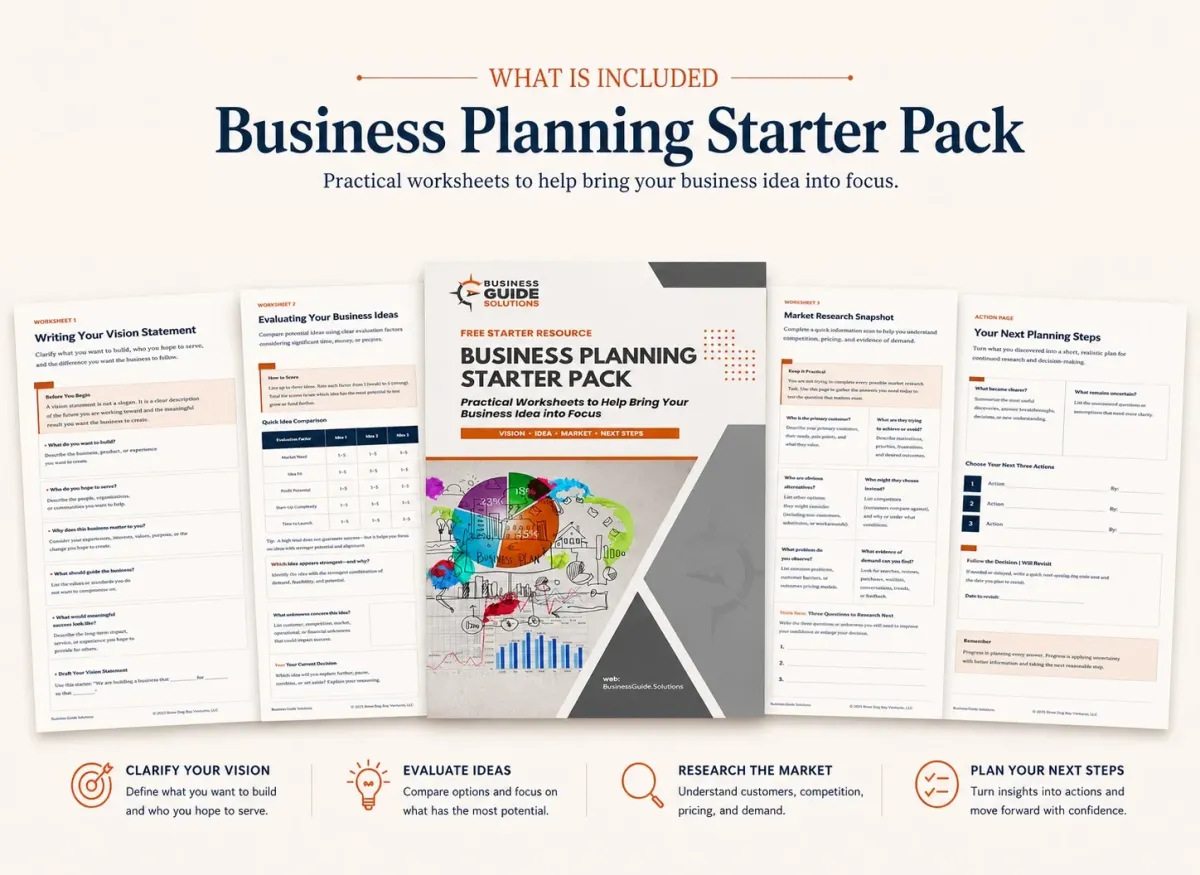
From Idea to Action: Business Planning Starter Pack is a 14-page planning resource designed to help you slow the thinking down and look more carefully at the early decisions behind your business.
Rather than asking you to complete a full business plan, it walks you through clarifying your vision, evaluating the idea, examining the market, and gathering what you learn into priorities you can carry forward.
Each worksheet goes beyond a few quick prompts. You will question assumptions, look for evidence, identify what is still uncertain, and consider what deserves more research before you commit additional time, money, or energy.
14-page printable PDF • Three in-depth, multi-page worksheets • Planning checkpoint • Guided next-step resources
What You’ll Work Through in the Starter Pack
This is more than a few fill-in-the-blank pages. Each section helps you think through an early business decision, notice what you may be assuming, and identify where better information could change what you do next.
01 · VISION
Writing Your Vision Statement
A two-page worksheet for defining what you want to build, who you hope to serve, why the business matters, what you want to protect as it grows, and what meaningful success could look like. You will bring those ideas together into a working vision you can continue refining.
02 · BUSINESS IDEA
Evaluating Your Business Ideas
A two-page decision tool for comparing promising ideas using demand, personal fit, startup feasibility, profit potential, and long-term interest—without allowing a score to make the decision for you. Then look beyond the numbers at evidence, risks, assumptions, and what needs to be tested next.
03 · MARKET
Market Research Snapshot
A two-page market research worksheet for getting closer to the customer, problem, alternatives, pricing expectations, and evidence of demand. You will distinguish facts from assumptions, look for patterns, and identify the questions that would most improve your understanding.
04 · NEXT STEPS
Gather What You’ve Learned
A Planning Checkpoint for stepping back from the worksheets and identifying what became clearer, what remains uncertain, what appears worth exploring further, and what could complicate progress. You will finish by choosing three priorities to carry forward.
The Starter Pack also includes guidance for using the worksheets, help deciding what kind of support may be useful next, and additional resources for continuing your planning and business-building work.
When you are ready for a much broader collection of hands-on tools, The Entrepreneur’s Toolkit continues the work with worksheets, planners, checklists, templates, and decision tools across the business.
Send From Idea to Action to Your Inbox
Enter your information below to receive the 14-page From Idea to Action: Business Planning Starter Pack.
USE THE WORKSHEETS WITH PURPOSE
A Simple Way to Work Through Your Starter Pack
You do not need to complete every page in one sitting or have every answer before you begin.
Use the Starter Pack to capture what you know today, notice what you may be assuming, gather better information, and decide what deserves attention next.
01
Begin with What You Know
Put your current thinking on paper without waiting for every detail to feel settled. The goal is not polished answers. It is to create something you can examine, question, and build upon.
Start with what feels reasonably clear today, and make a note wherever you are unsure. Those uncertain areas often become useful clues about what deserves more thought or research.
02
Notice What You’re Assuming
Pay attention to the places where your answers depend more on what you believe than on what you know. Assumptions are not necessarily wrong, but they are worth recognizing before they quietly shape larger decisions.
Use those gaps to identify the research, conversations, pricing information, or other evidence that would give you something stronger to work with.
03
Learn Before You Lock Things In
Use customer conversations, market research, pricing information, feedback, and experience to test what you believed. Let better information shape the decision rather than protecting an assumption.
Better information may confirm what you were thinking—or show that the idea needs to change. Either outcome is useful for making a more informed decision.
04
Decide What Deserves Attention Next
Step back from what you learned and identify the questions, decisions, or opportunities that deserve more attention. You are not trying to solve everything—you are deciding what matters next.
Choose a few priorities you want to keep in view, and let the rest wait until better information makes them relevant. This gives you a place to begin without making every question urgent.
The purpose is not to create a perfect plan in one attempt. It is to make your thinking visible, improve it with better information, and make the next decision more wisely.
CHOOSE THE SUPPORT YOU NEED
Begin with the Starter Pack. Go Deeper When You Are Ready.
From Idea to Action gives you a focused place to begin thinking through your vision, business idea, market, and priorities. When you are ready to work through the broader business-building process, the Guide and The Entrepreneur’s Toolkit provide deeper guidance and a much larger collection of practical tools.
FREE STARTING POINT
From Idea to Action: Business Planning Starter Pack
A focused 14-page resource for clarifying your vision, evaluating the business idea, examining the market, challenging assumptions, and deciding which priorities deserve attention next.
You’ll work through:
Writing and shaping your working vision
Evaluating your business ideas
Looking beyond the score at evidence and assumptions
Market research and evidence of demand
A Planning Checkpoint for gathering what you learned
Three priorities to carry forward
A thoughtful starting point when you want to understand the idea better before making larger commitments.
COMPLETE BUSINESS-BUILDING SUPPORT
How to Start a Business + The Entrepreneur’s Toolkit
The complete Guide provides the explanations, direction, and practical steps needed to move from an early idea through planning, launch, systems, marketing, growth, leadership, and long-term sustainability.
The Entrepreneur’s Toolkit gives you a hands-on place to apply what you are learning through worksheets, planners, checklists, templates, and decision tools that span the business.
The complete resources include:
Guidance across the full business-building journey
The complete collection of worksheets and planning tools
Financial, systems, operations, marketing, and leadership resources
Checklists, templates, planners, and decision tools
Resources you can revisit as the business develops
For when you want deeper understanding and practical tools for working through the business as a whole.
CONTINUE EXPLORING
More Resources to Help You Build with Clarity
Planning is only one part of building and leading a business. Continue exploring practical guidance for marketing and messaging, choosing technology thoughtfully, and learning as new questions and responsibilities arise.
MARKETING GUIDANCE
Marketing & Messaging
Explore practical guidance for understanding your audience, clarifying your message, strengthening the customer journey, and making more thoughtful marketing decisions.
You’ll find help thinking through visibility, positioning, communication, and the choices that help the right people understand what you offer and why it may matter to them. The goal is not to market everywhere, but to communicate more clearly and use the channels that make sense for the people you are trying to reach.
TOOLS AND TECHNOLOGY
Build Your Business Tech Stack
Learn how to evaluate business technology based on your actual needs, how well it fits your workflow, and whether it simplifies the business rather than adding unnecessary complexity.
Technology should support the way the business works—not become another source of confusion. Explore how to think through integrations, overlapping tools, automation, cost, and the trade-offs involved in keeping your systems connected.
CONTINUED LEARNING
Focused Learning & Resources
Find articles, guides, assessments, planners, and other focused resources for the questions and responsibilities that arise as your business develops.
Use this area when you want to explore a specific topic more deeply, strengthen your understanding, or find practical support for a decision you are working through now—or a responsibility you are carrying at this stage of growth.
QUESTIONS & GUIDANCE
Questions About Planning & Decision Tools
Planning tools are most useful when you understand what they are designed to help you think through—and what they cannot decide for you.
Use these answers to understand where to begin, how to revisit your work, and when broader guidance or professional expertise may be helpful.
Where should I begin with the Starter Pack?
Begin with the Vision section. It helps you clarify what you want to build, who you hope to serve, why the business matters, and what you want the business to make possible.
From there, move through the Idea and Market sections before using the Planning Checkpoint to gather what you learned and identify the priorities worth carrying forward.
Do I need a complete business plan before starting a business?
Not every business requires a lengthy formal plan before taking an initial step. However, you should understand the customer you intend to serve, the offer you plan to provide, your expected costs, how the business may earn money, and the major responsibilities involved.
A more formal business plan may be necessary when seeking financing, bringing in partners, or making significant financial commitments.
Is the Starter Pack the same as The Entrepreneur’s Toolkit?
No. From Idea to Action is a focused introductory resource built around four areas: vision, business idea, market, and priorities.
The Entrepreneur’s Toolkit is a much broader collection of worksheets, planners, checklists, templates, and decision tools designed to support the business across planning, setup, systems, marketing, growth, and leadership.
Can I use these planning tools for an existing business?
Yes. Existing business owners can use the worksheets to revisit their direction, evaluate a new offer or opportunity, reconsider their target customer, and identify assumptions that may need updated research.
Planning is not only for the startup stage. It can also help established businesses make more thoughtful decisions as circumstances change.
How often should I revisit my planning?
Revisit your thinking whenever you learn something significant about your customers, market, costs, competition, capacity, or direction.
It is especially useful before making a major decision, introducing a new offer, entering a new market, or committing significant time or money. Good planning develops with the business rather than remaining frozen after the first pass.
Can planning tools replace legal, tax, accounting, or financial advice?
No. These worksheets are educational planning tools intended to help you organize your ideas, research, and decisions.
They do not replace advice from a qualified attorney, accountant, tax professional, financial adviser, insurance professional, or other appropriately licensed expert.
TAKE THE NEXT THOUGHTFUL STEP
Turn Your Thinking Into a More Informed Next Step
You do not need every answer before moving forward. Start by putting what you know into words, questioning what you are assuming, and identifying the information that would help you make a wiser decision.
From Idea to Action gives you a focused place to begin. When you want broader guidance for the business as a whole, continue with How to Start a Business.
© 2025-present BusinessGuide.Solutions. All Rights Reserved.
A steady resource for building, growing, and leading well.


