
MARKETING & MESSAGING
Clarify Your Message. Build Marketing with Greater Direction.
Marketing becomes easier to navigate when you understand what you want people to know, who you are trying to reach, and how your message should guide them toward a meaningful next step.
Use practical frameworks to strengthen your message, understand your audience, organize the customer journey, and make marketing decisions with greater clarity and purpose.
01
MARKETING WITH GREATER CLARITY
A marketing framework does not replace creativity. It gives your ideas enough structure to become clearer, more consistent, and easier to act on.
Clear Marketing Begins with a Structure You Can Follow
Marketing often feels complicated because business owners are trying to make too many decisions at once—what to say, where to show up, who to reach, and how to encourage someone to take the next step.
A marketing framework provides a repeatable structure for organizing those decisions. It helps you understand how your message, audience, offer, channels, and customer journey work together rather than treating each tactic as a separate activity.
The purpose is not to make every campaign look or sound the same. It is to give your marketing enough structure that creativity can support the strategy rather than having to replace one.
When you understand the structure behind effective marketing, it becomes easier to communicate consistently, evaluate what is working, and make more thoughtful decisions about where to focus your time and resources.
Clarify Your Message
Communicate what you offer, who it is for, and why it matters in language people can quickly understand and easily recognize as relevant.
Understand Your Audience
Focus your marketing on the people most likely to need, value, and respond to what your business provides and see as relevant.
Guide the Customer Journey
Help potential customers move from first awareness to understanding, trust, meaningful action, and a stronger long-term relationship.
FROM MESSAGE TO MOMENTUM
Four Marketing Frameworks That Bring Your Strategy into Focus
Effective marketing is not a collection of disconnected posts, emails, advertisements, and promotions. Each activity should support a clear message, reach an appropriate audience, guide people through a thoughtful experience, and produce information you can use to improve.
These four frameworks help you organize the decisions that shape effective marketing and understand how they influence one another. Start with the area that feels least clear, then return to the others as your business, audience, and opportunities develop.
01 · MESSAGE
Clarify Your Message
Define what your business offers, who it is intended to help, what problem or desire it addresses, and why someone should pay attention.
A clear message gives every marketing channel a consistent foundation and helps potential customers quickly understand whether your business is relevant to them.
FOUNDATION FOR EVERY MARKETING CHANNEL
02 · AUDIENCE
Understand Your Audience
Identify the people most likely to need, value, and respond to what your business provides.
Understanding their priorities, questions, concerns, motivations, and preferred sources of information helps you create marketing that feels relevant rather than broad or impersonal.
AUDIENCE CLARITY FRAMEWORK
03 · JOURNEY
Guide the Customer Journey
Consider what potential customers need at each stage—from first becoming aware of the business to evaluating the offer, making a decision, and returning after the sale.
A clear journey helps you provide the right message, information, reassurance, or invitation at the moment it is most useful.
CUSTOMER JOURNEY FRAMEWORK
04 · IMPROVEMENT
Measure, Learn, and Improve
Choose meaningful indicators that help you understand whether your marketing is attracting attention, creating engagement, producing inquiries, supporting sales, and strengthening customer relationships.
Reviewing the results regularly allows you to improve what is working, adjust what is not, and focus your time and resources more intentionally.
CONTINUOUS IMPROVEMENT FRAMEWORK
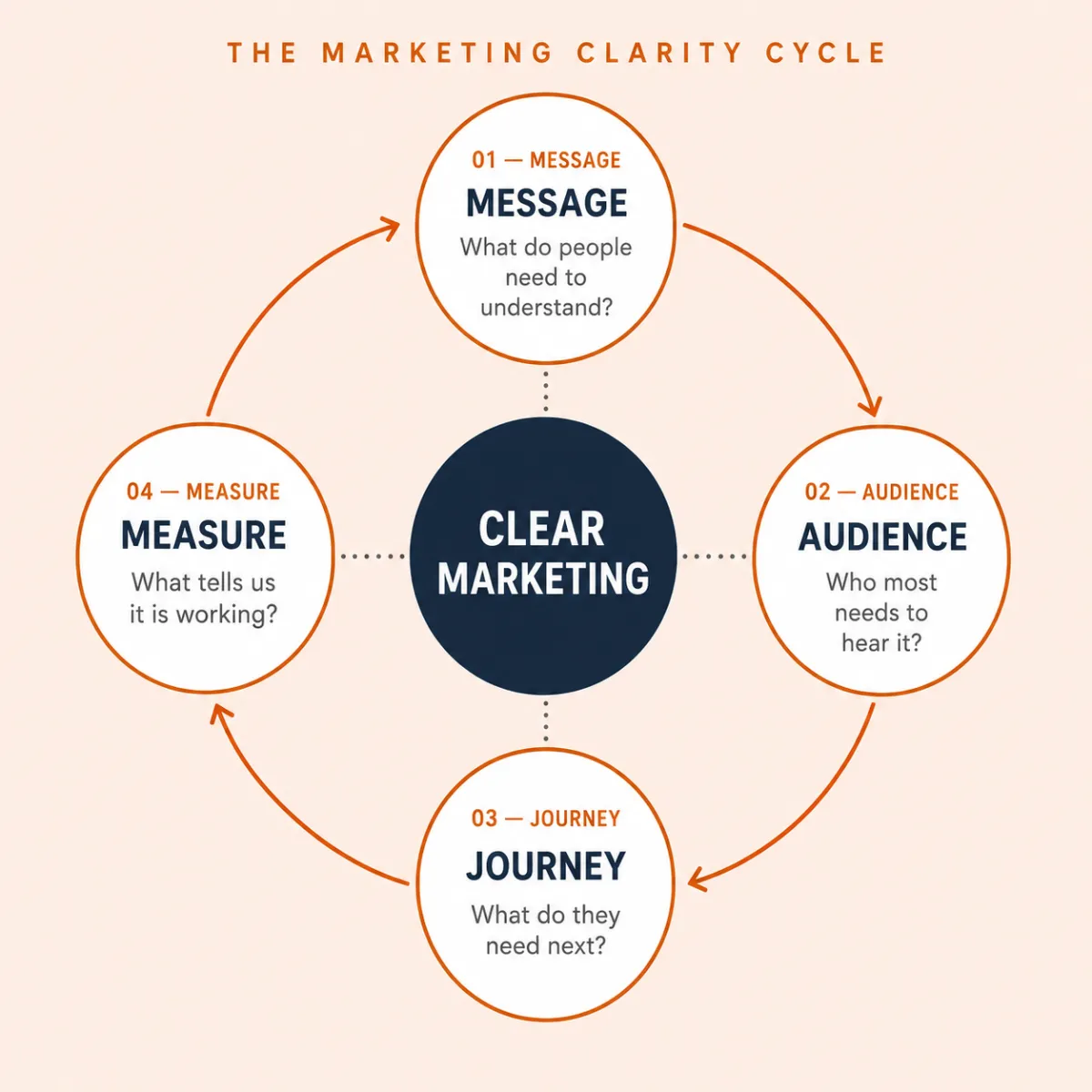
HOW THE FRAMEWORKS WORK TOGETHER
See How the Four Marketing Decisions Work Together
Strong marketing rarely comes from one isolated tactic. Your message, audience, customer journey, and results continually influence one another.
A clear message is only effective when it reaches the right people. Reaching the right people is not enough unless they understand what to do next. And even a thoughtful campaign must be reviewed so you can learn what is working and what needs to change.
Use this cycle when you are planning a campaign, creating content, introducing an offer, refining your message, or reviewing what your marketing is producing.
Message
Clarify what you want people to understand, remember, and believe about your business or offer.
Audience
Identify the people most likely to need, value, and respond to that message.
Journey
Determine the information, reassurance, and invitation they need before taking the next step.
Measure
Review the results so you can strengthen what is working and adjust what is not.
When one part of the cycle changes, revisit the others. Thoughtful marketing remains aligned as the business, audience, offer, and opportunities develop.
USE THE FRAMEWORKS WITH PURPOSE
A Simple Way to Put Marketing Frameworks to Work
You do not need to rethink your entire marketing strategy at once.
Choose one campaign, offer, audience, or marketing challenge and use the frameworks to examine it more clearly. Working through one decision at a time makes it easier to see what needs attention, what you already understand, and what should happen next.
01
Begin with a Clear Goal
Choose one specific result you want your marketing to support, such as increasing awareness, generating inquiries, promoting an offer, or encouraging repeat business.
A defined goal helps you select the right message, audience, customer journey, and measures rather than trying to accomplish everything through one campaign.
02
Work Through the Four Questions
Clarify what people need to understand, who most needs to hear it, what they should experience next, and how you will recognize meaningful progress.
Reviewing all four areas helps prevent individual tactics from becoming disconnected from the larger marketing strategy and the goals it is meant to support.
03
Review, Learn, and Improve
After the marketing activity has had time to produce results, compare what happened with the goal you originally established.
Identify what attracted attention, created engagement, encouraged action, or caused confusion. Use what you learn to improve the next message, campaign, or customer experience with greater intention.
Marketing becomes more useful when you make thoughtful decisions, pay attention to what happens, and use what you learn to improve what comes next.
CHOOSE THE LEVEL OF GUIDANCE YOU NEED
Begin with a Framework. Build a More Complete Marketing Strategy.
The frameworks on this page give you a practical way to work through an immediate marketing question. When you want to understand how messaging, visibility, offers, customer experience, sales, and long-term growth fit together, the Guide and The Entrepreneur’s Toolkit provide deeper guidance and hands-on tools.
PRACTICAL STARTING POINT
Four Marketing Frameworks
Use these four practical structures to examine one message, audience, campaign, offer, or customer-journey question with greater clarity.
The frameworks help you:
Clarify the message people need to understand
Identify the audience most likely to respond
Guide potential customers through the next appropriate step
Measure results and improve future marketing decisions
A useful starting point when one part of your marketing needs clearer thinking before you add more activity.
DEEPER MARKETING DIRECTION
How to Start a Business + The Entrepreneur’s Toolkit
The Guide goes beyond individual marketing decisions to help you understand how branding, messaging, visibility, content, offers, sales, customer experience, and long-term growth work together.
The Entrepreneur’s Toolkit gives you practical worksheets, planners, checklists, templates, and decision tools for applying that guidance across the business.
The marketing resources include:
Branding, positioning, and messaging guidance
Customer understanding and audience-development tools
Content, website, SEO, and visibility guidance
Marketing planning, social media, and email tools
Offers, customer journey, sales, and follow-up resources
Retention, referrals, partnerships, and growth planning
For when you want to move beyond one marketing question and understand how the pieces work together.
CONTINUE EXPLORING
More Resources to Support Your Business
Marketing works better when it is supported by thoughtful planning, dependable systems, and continued learning. Explore additional resources for strengthening the decisions and structure behind the business.
PLANNING RESOURCES
Planning & Decision Tools
Use practical planning and decision tools to clarify ideas, examine assumptions, research important questions, and work through the decisions shaping your business with greater clarity and confidence.
TOOLS AND TECHNOLOGY
Build Your Business Tech Stack
Learn how to evaluate technology based on what your business actually needs, how well tools fit together, and whether they simplify your work rather than add unnecessary complexity.
CONTINUED LEARNING
Educational Resources
Find articles, guides, assessments, planners, and other focused resources for the questions and responsibilities that arise as your business develops and as new priorities emerge.
Want to go deeper on a specific marketing question?
Explore practical articles on messaging, content, customer journeys, visibility, follow-up, and sustainable growth.
QUESTIONS & GUIDANCE
Questions About Marketing Frameworks
Marketing frameworks are designed to simplify important decisions—not create another complicated system to maintain.
Use these answers to understand where to begin, how to adapt the frameworks to your business, and how they support a broader marketing strategy.
What is a marketing framework?
A marketing framework is a simple structure for organizing the decisions behind a message, campaign, offer, or customer experience.
Rather than beginning with a tactic, it helps you think through what you are trying to accomplish, who you need to reach, what people need to understand or experience, and how you will know whether the effort is working.
Which marketing framework should I begin with?
Begin with the area that is currently creating the most confusion.
If people do not understand what you offer, start with your message. If your marketing reaches many people but produces little response, review your audience. If potential customers lose interest before taking action, examine the customer journey. If you are unsure what is working, begin with measurement.
Can I use these frameworks for every marketing channel?
Yes. The same underlying decisions can support website copy, email campaigns, social media, advertising, presentations, events, partnerships, direct mail, and other marketing activities.
The channel may change, but your message, audience, customer journey, and intended result should remain aligned.
Do marketing frameworks limit creativity?
No. A useful framework gives creativity direction without prescribing exactly what every campaign must look or sound like.
It helps ensure that creative ideas support a clear purpose, reach the appropriate audience, and guide people toward a meaningful next step.
How often should I review my marketing frameworks?
Review them whenever you introduce a new offer, target a different audience, begin a major campaign, change your message, or notice that marketing results are weakening.
You should also revisit them as customer needs, market conditions, business priorities, or available marketing channels change.
What should I measure to know whether my marketing is working?
The right measure depends on the goal.
Awareness efforts may focus on reach, website visits, or branded searches. Engagement efforts may consider replies, downloads, inquiries, or time spent with content. Sales-focused activity may track qualified leads, conversion rates, revenue, repeat purchases, or customer retention.
Choose measures that reflect meaningful progress rather than relying only on activity or visibility.
MARKET WITH GREATER CLARITY
Clarify Your Message. Strengthen the Marketing Behind It.
Effective marketing is not about producing more simply for the sake of staying visible. It begins with understanding what you want people to know, who you are trying to reach, what should happen next, and what the results are telling you.
Use the four frameworks when you need to work through a specific marketing decision. When you want broader guidance for connecting marketing to the rest of the business, continue with the Guide.
STAY CONNECTED
Build with more clarity each week.
Join Business Insights Weekly for practical business guidance, thoughtful perspective, useful tools, and ideas you can apply as you build, grow, and lead.
Practical guidance, thoughtful updates, and no inbox overload. Unsubscribe anytime.
© 2025-present BusinessGuide.Solutions. All Rights Reserved.
A steady resource for building, growing, and leading well.


